The heatwave currently affecting Europe has made the urgency of climate action more apparent than ever. At the same time, the UN climate negotiations held in Bonn in June once again demonstrated just how difficult it is to reach international agreement on emissions reductions and the energy transition. No agreement was reached on several key issues, while a noteworthy geopolitical shift also became increasingly evident: China is taking a more prominent role in supporting international climate cooperation. Reporting from the Bonn climate talks, fossil fuel-producing countries continue to seek to slow down the energy transition, while the coming months will be decisive for the success of the COP31 Climate Change Conference in November.
Last year’s Belém Climate Change Conference (COP30) resulted in a serious loss of trust within the international community, with virtually every country except the major oil-producing states leaving the Amazonian host city deeply disappointed. Consequently, over the past few months government representatives have repeatedly stressed the need to rebuild mutual trust and confidence in the international climate negotiations, while also calling for political manoeuvring to give way to substantive technical work. The challenges experienced at COP30 even prompted the European Union to launch an internal reform process aimed at strengthening the bloc’s effectiveness in climate negotiations. Meanwhile, the Iranian oil price crisis led many to call for a faster energy transition, and the United Nations General Assembly adopted a resolution reaffirming States’ responsibility to take action against climate change.
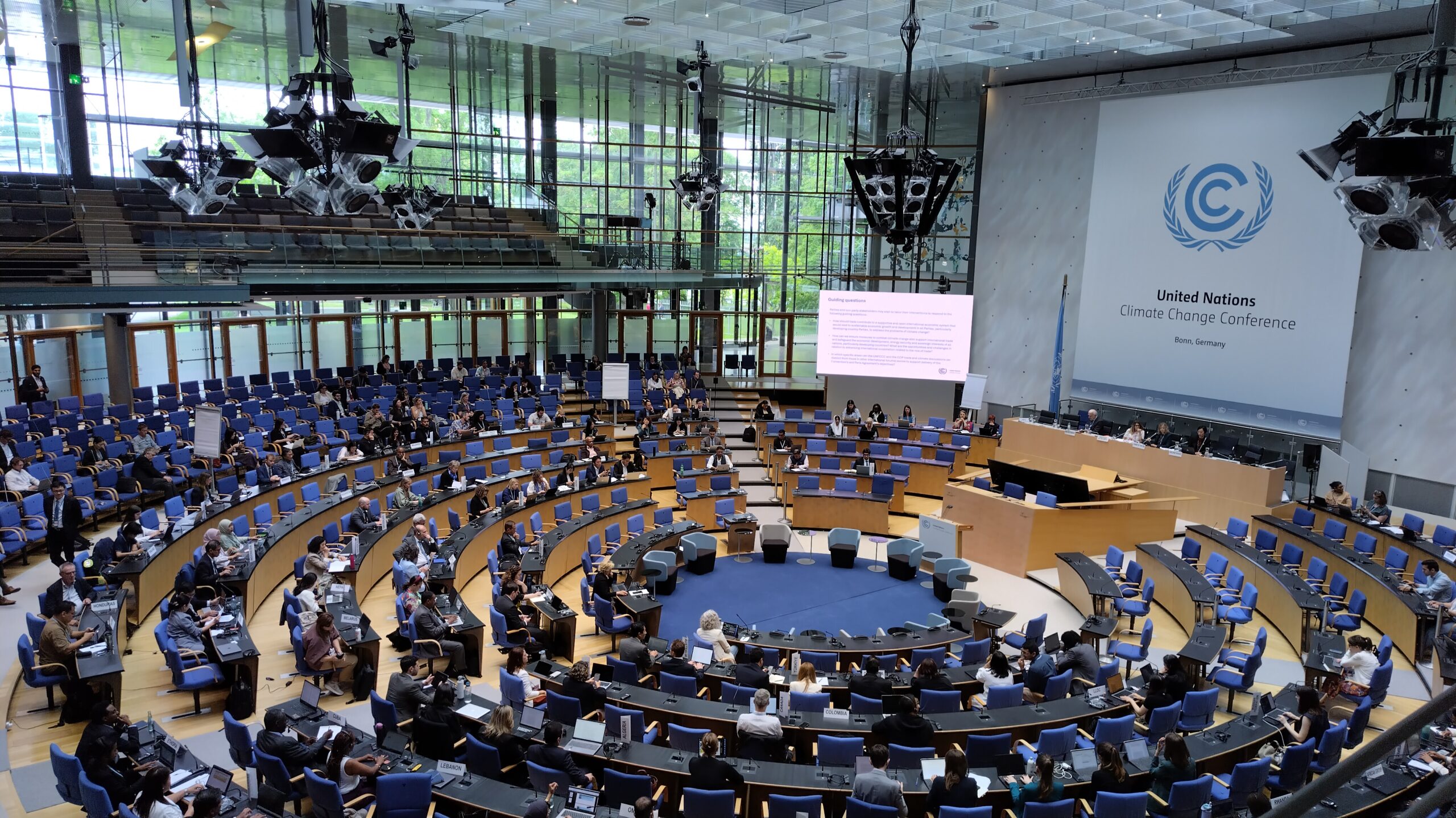
Against this backdrop, the sixty-fourth sessions of the Subsidiary Bodies (SB64) under the United Nations Framework Convention on Climate Change (UNFCCC) were recently held in Bonn, Germany. Many had hoped that the meeting would mark the beginning of the much-needed “confidence-building healing process” and allow technical negotiations to resume in earnest. However, after two weeks of negotiations—dominated by disputes over the energy transition and scientific issues—the Executive Secretary of the UN Climate Change Secretariat expressed disappointment and criticised governments for “cherry-picking” among their existing commitments and deliberately slowing the negotiating process.
Although the session got off to a promising start—with Parties agreeing on the agendas without the procedural disputes that have delayed negotiations in previous years, allowing work to begin on schedule—persistent political disagreements continued to hamper progress on scientific, financial, mitigation and trade-related issues.

In the final hours of the negotiations, Parties unsuccessfully attempted to reach a compromise that would have balanced, on the one hand, the demands of ambitious countries—including Small Island Developing States (SIDS), Least Developed Countries (LDCs), and developed countries—to accelerate mitigation efforts in line with the latest scientific findings, and, on the other hand, the demands of oil-producing countries to include discussions on the relationship between trade and climate change. The latter initiative is primarily aimed at scrutinising the European Union’s climate policies in an effort to slow down the EU’s energy transition, which poses a threat to the export revenues of fossil fuel-producing countries.
Ultimately, the negotiations ended in deadlock. Parties failed to agree on draft conclusions in at least three key areas of the climate agenda, including adaptation and mitigation. As a result, these issues will have to be revisited at COP31, to be held in Türkiye in November.
Attack on science as China emerges as a new key player in climate negotiations
Mitigation remains the single most important instrument for addressing climate change, yet it was once again subject to sustained political attacks during the Bonn negotiations.
The Paris Agreement, adopted in 2015, is built around an ambition mechanism under which Parties periodically assess collective progress in addressing climate change through the Global Stocktake (GST) and subsequently adjust their national climate commitments through their Nationally Determined Contributions (NDCs) in light of its outcomes.
The next Global Stocktake will take place in 2028, but its technical preparations must begin this year. One of the principal foundations of the process is the scientific assessment produced by the Intergovernmental Panel on Climate Change (IPCC). However, fossil fuel-producing countries have consistently sought to undermine the Panel by questioning its credibility and attempting to prevent the findings of its reports from informing the next Global Stocktake.
In response, a coalition of climate-vulnerable developing and developed countries held an international press conference to defend science and the scientific community, while publicly condemning those countries whose fossil fuel interests have driven coordinated attacks on scientific evidence.

Similarly, little progress has been achieved under the Mitigation Work Programme (MWP), the process established to discuss concrete actions to accelerate emissions reductions. Since its establishment in 2022, the Programme has delivered few substantive outcomes, largely because Parties have been unable to reach a common understanding of its scope and objectives, primarily due to resistance from fossil fuel-producing countries. Although the continuation of the Work Programme and its review were expected to be among the key issues discussed during the two-week Bonn session, negotiations once again failed to produce meaningful progress.
While many Parties expressed disappointment at the conclusion of the Bonn meeting, China argued that at least some common ground had been established on several issues that could serve as a foundation for progress at COP31. One such point of convergence was the shared recognition that “no Party opposes the implementation of mitigation measures or the enhancement of ambition.”
It is worth noting that China has increasingly adopted a more progressive stance in the international climate negotiations. During the recent ministerial meeting held in Brussels, China also reaffirmed its support for international cooperation and the global green transition. Given the climate-sceptical approach of the current United States administration, China’s constructive engagement has become increasingly important for maintaining momentum in international climate cooperation.
Adaptation and climate finance: where genuine interests collide with political leverage
Small Island Developing States (SIDS), Least Developed Countries (LDCs) and developed countries voiced deep frustration over the lack of progress on the Global Goal on Adaptation (GGA). Their expectation had been that the Bonn session would launch the technical work needed to operationalise the indicators adopted at COP30 in Brazil.
Instead, negotiations reached an impasse after African countries proposed appointing government representatives to the technical expert body responsible for overseeing the process. Several Parties considered this unacceptable, arguing that the body should remain independent and composed of technical experts in order to safeguard the scientific integrity and quality of its work.
Efforts to rebuild trust among Parties were further complicated by disagreements between developed countries and a number of developing countries over whether the previously agreed objective of tripling adaptation finance by 2035 should be incorporated into the technical document focusing on methodologies and indicators for measuring resilience to climate impacts. For African countries, including this political commitment represented a clear red line.

Climate finance was also used as a political bargaining tool, particularly by Arab countries and the Like-Minded Developing Countries (LMDC) group—which includes Saudi Arabia and India—as was the issue of international trade.
The most contentious issues carried over from COP30 concerned the insistence of these country groups that discussions on climate finance should focus exclusively on the amount of financial support provided by developed countries to developing countries, while excluding broader questions such as greening public expenditure, development finance, private-sector investment and the global financial system, as well as the phase-out of fossil fuel subsidies.
In addition, these countries continued to press for a dedicated agenda item under which European Union climate policies—most notably the Carbon Border Adjustment Mechanism (CBAM)—could be scrutinised. Throughout the Bonn negotiations, fossil fuel-producing countries repeatedly sought to introduce these issues under virtually every agenda item, thereby increasing political pressure on developed countries and further slowing the pace of negotiations.
Agreement reached on just transition as Türkiye presents a new global electrification target
Although this year’s UN mid-year climate conference will not be remembered as a particularly successful negotiating session, it nevertheless produced several encouraging developments.
One of the few agenda items that progressed in a more constructive atmosphere was just transition—that is, how to ensure that the transition towards a climate-neutral economy and society is implemented fairly and inclusively, from the global level down to local communities.
Parties adopted the terms of reference for the review of the Just Transition Work Programme (JTWP), which was launched in 2023. In addition, the first proposals were tabled in Bonn outlining the structure and key operational elements of a new Just Transition Mechanism. The objective is to formally establish the mechanism at COP31 in November.
In addition, under the dual Turkish–Australian Presidency of this year’s COP31, Türkiye will lead work on the Global Climate Action Agenda (GCAA). During the Bonn Climate Change Conference, Türkiye presented a new global electrification target, aiming to increase electricity’s share in final energy consumption worldwide from approximately 20% today to 35% by 2035.
The target would be achieved through the accelerated deployment of technologies such as heat pumps, electric vehicles and electric cooking appliances.
However, it is important to note that many aspects of this initiative remain unclear. For example, it has yet to be determined whether only electricity generated from clean energy sources will count towards the target. From a policy perspective, it is also evident that electrification targets alone will have only limited impact unless they are accompanied by concrete plans to phase out fossil fuels.
In this regard, the Presidency of last year’s COP, Brazil, is currently developing a global fossil fuel phase-out roadmap together with several supporting initiatives involving governments and civil society organisations. At present, however, it remains uncertain how these initiatives will be integrated into the UN climate process—if indeed they become part of it at all.
What lies ahead for international climate policy?
The informal consultations scheduled over the coming months—including the Baku Climate Week and the Pacific ministerial preparatory meetings—will play a crucial role in enabling political leaders to resolve issues that have proven impossible to settle at the technical level.
Accordingly, Simon Stiell, Executive Secretary of UN Climate Change (UNFCCC), called on the Turkish and Australian COP31 Presidencies to engage ministers as quickly as possible in addressing the UN climate process’s “most difficult issues”, so that negotiations can finally move into the “fast lane.”

There are, nevertheless, reasons for cautious optimism. For the first time in several years, the annual UN climate negotiations will be jointly led by one developed and one developing country, helping to bridge the traditional divide between negotiating groups.
Amid increasingly severe heatwaves, more frequent extreme weather events and recurring energy price crises, the urgency for countries to set aside short-term political and economic interests and work together to address climate change is growing by the day.