
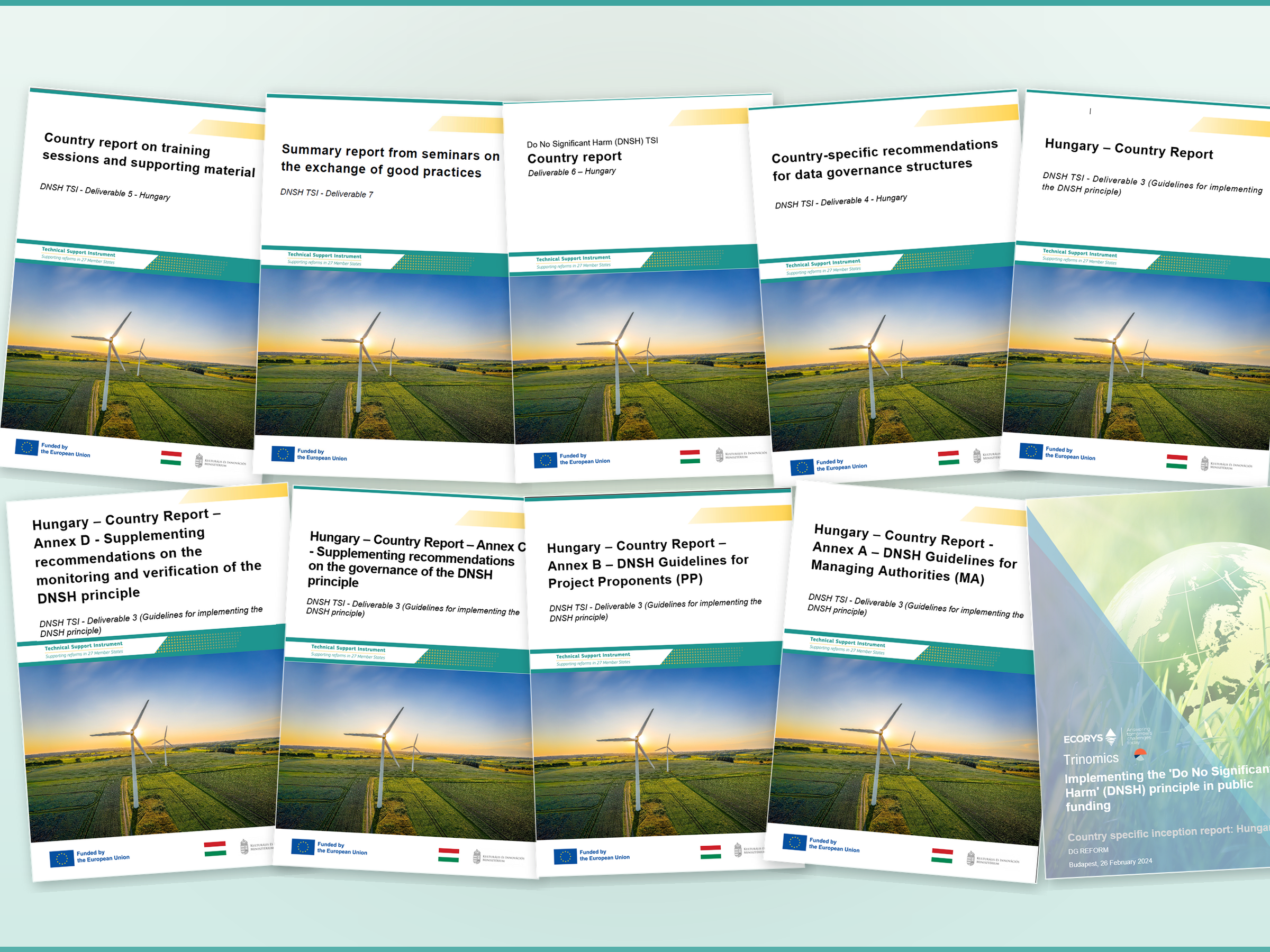
How can we ensure that investments implemented using EU and national funds do not cause significant environmental harm? A multi-year project involving eight European countries provided guidance to selected public authorities on how to implement this EU legal requirement. The Green Policy Center participated in the project as the Hungarian partner. During the recently concluded cooperation, we worked with Hungarian and international partners to strengthen the practical application of the DNSH principle in Hungary.
What does DNSH mean?
The DNSH – Do No Significant Harm – principle is intended to ensure that an investment considered beneficial from an environmental perspective does not cause significant harm to other environmental objectives.
The principle is set out in the European Union’s Taxonomy Regulation and is also a mandatory legal requirement for the use of most EU funds. The aim is to ensure that EU funds are not only used efficiently from an economic perspective, but also contribute to achieving climate and environmental objectives.
This is particularly important in the case of large-scale EU funding programmes, such as the Recovery and Resilience Facility (RRF), cohesion policy and the InvestEU programme.
Cooperation across eight countries
The project involved Austria, Belgium, Hungary, Italy, Latvia, Slovakia, Slovenia and Spain, with the support of the European Commission’s Directorate-General for Structural Reform Support (DG REFORM).
The Green Policy Center served as the Hungarian partner and professional hub in the project. An important feature of the cooperation was that, although the participating countries faced a number of similar challenges, the legal and institutional conditions for applying the DNSH principle differed significantly. Therefore, alongside the joint professional work, it was necessary to develop solutions tailored to the specific national context in each country.
From situation assessment to pilot projects
As part of the work in Hungary, we first assessed how the DNSH principle is already being applied in Hungary, how it could be further applied, and what legal, institutional or practical gaps may hinder its implementation. The project focused primarily on the education sector and its building stock.
Based on this assessment, practical guidance was developed covering, among other things, monitoring and reporting tasks related to project implementation, data management, and sustainable architecture. Training sessions and awareness-raising materials supported the development of professional knowledge and capacities.
An important part of the project was the implementation of pilot projects. These provided an opportunity to test the approaches developed in practice in selected sectors and investment projects. The experience gained through the pilots was also used to further develop the professional recommendations.
The participating countries also exchanged experiences and good practices on several occasions, creating opportunities to compare different approaches and solutions at the international level.
Broad cooperation with stakeholders
The project confirmed that the practical application of the DNSH principle can only be effective through broad institutional and professional cooperation.
Throughout the project, we worked closely with the relevant Hungarian ministries and public institutions, as well as with stakeholders involved in the pilot projects. Consultations with these actors helped ensure that the solutions developed were not only theoretically applicable, but also suited to the institutional and practical context in Hungary.
The cooperation also demonstrated that DNSH is not simply another administrative requirement. When applied appropriately, it can contribute to ensuring that investments financed from public funds remain aligned with climate and environmental objectives over the longer term.
For our professional team, participating as the Hungarian partner in this multi-year European cooperation was a valuable experience. It also provided an opportunity to contribute our expertise to strengthening the practical application of the DNSH principle in Hungary.